


Complete Collagen for Itchy Dogs: Skin, Coat & Joint Support With Salmon Oil
Complete Collagen for Itchy Dogs: Skin, Coat & Joint Support With Salmon Oil
For dogs that scratch, lick and chew: skin and coat support from the inside, with joint support in the same daily dose.
Supports calmer, more comfortable skin in dogs that scratch, lick and chew.
Supports a softer, shinier coat and well-moisturized skin.
Supports joint comfort and easy movement, from the same daily dose.
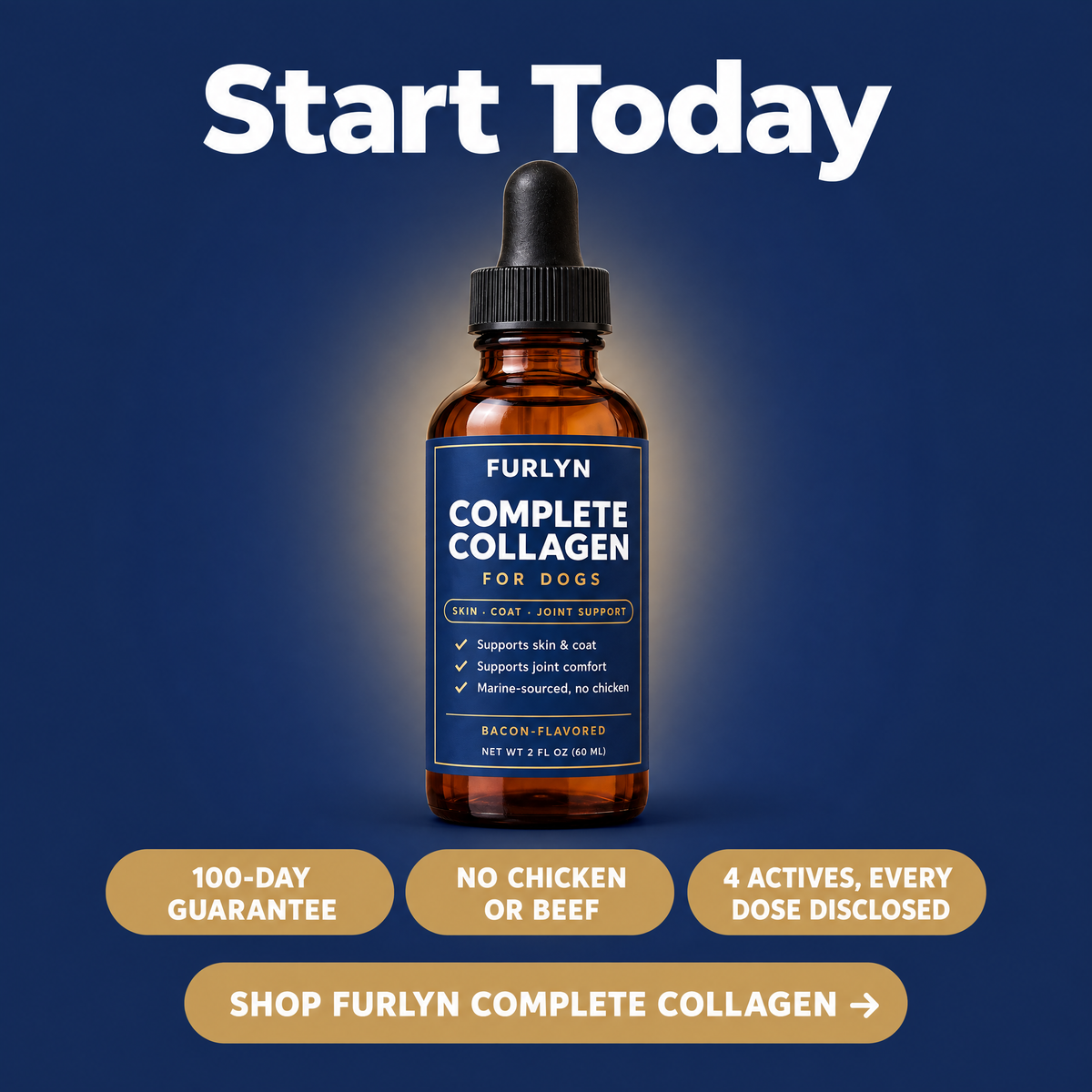
Marine-sourced: no chicken, no beef
99% reaches the skin & joints vs 12% for chews
Couldn't load pickup availability

Complete Collagen for Itchy Dogs: Skin, Coat & Joint Support With Salmon Oil
What's Inside
What's Inside
Four actives, every dose disclosed — no proprietary blends.
- Marine Collagen (Types I & III) — ~400 mg/mL — supports skin structure
- Salmon Oil (Omega-3, EPA/DHA) — supports the skin's natural oil barrier
- Hyaluronic Acid — ~1–2 mg/mL — supports moisture retention
- Glucosamine (plant-fermented, not shellfish) — supports joint comfort
Free from: chicken, beef, pork, xylitol, fillers.
The science behind It
The science behind It
Your dog's skin has a protective barrier made of collagen and it's breaking down faster than you think.
Dogs lose 7-10% of their collagen every year after age 2. Genetics, chronic scratching, antibiotics, and poor diet can accelerate it even faster. That's why some 2 or 3-year-old dogs already have chronic skin issues.
As collagen depletes, gaps form. Allergens penetrate deep. The immune system goes into overdrive. That's the constant itching, hot spots, and scratching that never stops.
Furlyn gives the body the collagen it’s built from (types I & III, from wild deep-sea cod), already broken into small peptides so it absorbs, plus hyaluronic acid to hold moisture in the skin.
100-Day Guarantee
100-Day Guarantee
Give Furlyn a real chance: 100 days. If your dog’s skin and coat don’t improve, email us and we’ll refund you in full. Keep the bottle. No questions asked.
Dosage & How to use
Dosage & How to use
Mix into food once daily. Tasteless, dogs don't notice it.
Dosage by weight:
→ Under 25 lbs: 1 mL daily — one bottle lasts about 2 months
→ 25-75 lbs: 2 mL daily — one bottle lasts about 1 month
→ Over 75 lbs: 3 mL daily — one bottle lasts about 3 weeks
Your dog's barrier needs ongoing collagen to stay strong.
Shipping
Shipping
- Processing time (ships within 1–2 business days")
- Delivery window (5–7 days)


Real results from real dog owners.
-

The constant scratching and hot spots finally stopped.
2 years of Apoquel and she'd still wake us up at 3am clawing at her belly. Hot spots every few weeks, cone on, cone off, repeat. Tried every shampoo, every grain-free diet. Started Healthypetz on a whim — within 2 weeks the scratching had almost completely stopped. No new hot spots since. Her skin is healing and she's sleeping through the night. So am I.
-

He's stopped chewing his paws raw.
Cytopoint would work for a few weeks then we'd be straight back to the vet. The licking was constant — his paws were stained and inflamed between the toes. Three weeks on Healthypetz and the licking just stopped. The staining is fading and the skin between his pads is actually healing. First time in two years.
-

No more ear infections since week four.
Every two weeks it was the same cycle brown gunk, yeast smell, pulling away when I tried to clean them. Started this collagen after two years of ear drops and vet visits. Week four I cleaned his ears and the cotton pad came back white. Three months now and not a single infection. The vet said she's never seen his ears this clean.


Does this sound like your dog?
You're not imagining it, and you're not doing it wrong. Itchy dogs are hard to read, and harder to help.

Night scratching
The thumping leg on the bed frame, the tags jingling in the dark. Nobody in the house gets a full night.

Paw licking and chewing
You hear it from the other room. Rust-colored fur between the toes, and pink, sore-looking pads.

Red belly, itchy coat
Pink skin, flaky patches, a coat that has lost its shine. Baths and sprays help for a day.

Hot spots that come back
Raw patches that settle down and then show up again in the same places.


Also shows up as
- Constant face and ear rubbing
- Dry, flaky skin or dandruff
- Thinning or dull fur
- Shedding that never seems to stop
- Slow, stiff mornings
Every itchy dog has a different trigger: pollen, food, fleas, or something no one has found yet. Your vet can help you work out yours. What most itchy dogs share is skin that's under strain, and skin does better with the right support underneath. That's what we built Furlyn to give.

Skin Structure
Hydrolyzed from fish, broken down small enough to absorb. Supports the structure the skin is built on.

Oil Barrier
Supports the skin's natural oil layer, the film that helps seal moisture in.

Deep Hydratation
Holds water in the skin, so it stops flaking, cracking and pulling tight. Softer skin, calmer dog.

Joint Comfort
A bonus for the joints. Older dogs get up off the floor easier while their skin rebuilds.
You've probably tried all of this already
None of it was wrong to try. Here's what each one actually does, and where it stops.
| What you tried | What it does | Supports the skin long-term? |
|---|---|---|
| Shampoo, wipes, sprays | Cleans and soothes the surface for a day or two | No — rinses off, doesn't change what the skin is built from |
| Food change | Removes a possible trigger from the diet | Only if food was the trigger — most itchy dogs react to things in the environment, not food |
| Antihistamines, allergy meds | Calms the immune reaction in the moment | No — manages the flare-up, not the skin underneath |
| Other collagen chews | Right idea, but a chew has to survive digestion first | Some — depends on the dose and how much actually absorbs |
| Furlyn Liquid Collagen | Marine collagen, omega-3, HA and glucosamine, absorbed daily from a liquid | Supports skin structure, moisture and the oil barrier with continued use |
Shampoo, wipes, sprays
What it doesCleans and soothes the surface for a day or two
Supports the skin long-term?No — rinses off, doesn't change what the skin is built from
Food change
What it doesRemoves a possible trigger from the diet
Supports the skin long-term?Only if food was the trigger — most itchy dogs react to things in the environment, not food
Antihistamines, allergy meds
What it doesCalms the immune reaction in the moment
Supports the skin long-term?No — manages the flare-up, not the skin underneath
Other collagen chews
What it doesRight idea, but a chew has to survive digestion first
Supports the skin long-term?Some — depends on the dose and how much actually absorbs
Furlyn Liquid Collagen
What it doesMarine collagen, omega-3, HA and glucosamine, absorbed daily from a liquid
Supports the skin long-term?Supports skin structure, moisture and the oil barrier with continued use
None of these failed because you did something wrong. Most of them were never designed to reach the skin's structure. Furlyn is.

Why We Made It a Liquid
No fillers to react to: A chew needs starch or a binder to hold its shape. A liquid doesn't, so there's nothing extra in it for a sensitive stomach to work around.
Dosed to exact weight: A chew is one fixed size, whether your dog is 12 lb or 80 lb. The dropper measures the precise amount for the dog in front of you.
Mixes into any food: No pill to hide in cheese, no chew to spit out. A few drops on the food they already eat.
What to Expect, Week by Week

Collagen builds gradually. Here's the order things tend to happen.
-
Weeks 1–2
The itching starts to lose its edge.
Omega-3 and hyaluronic acid start supporting the skin's oil layer from the first dose. You might not see a difference yet, but the scratching often isn't quite as constant.
-
Weeks 3–6
The coat you remember starts coming back.
As barrier support builds, that dry, flaky coat starts feeling softer under your hand, and the licking at paws and belly tends to quiet down.
-
Weeks 8–12
Flare-ups stop showing up as often.
Marine collagen has had time to rebuild the structure underneath. When flare-ups do happen, they're shorter and further apart.
-
3+ months, ongoing
Getting up doesn't take a second try.
Glucosamine and collagen support to joints builds with consistent use — often showing up as easier movement, especially first thing in the morning.
Every dog is different, and consistency matters more than any single week.
How Furlyn Compares
Most collagen supplements skip at least one of these.
| Furlyn | Others | |
|---|---|---|
| No chicken or beef | ||
| Calmer, less-itchy skin | ||
| High absorption up to 99% | ||
| Fixes root of chronic itching | ||
| Skin, coat & joints in one | ||
| Filler Free Formula |
Why Collagen Isn’t Optional Anymore

96%
Of owners noticed less scratching after giving Furlyn daily for 3+ weeks
93%
Saw less paw licking and chewing within the first course.
90%
Would recommend Furlyn to a friend with an itchy dog at home
100-day money-back guarantee

DVM Recommendation
Most collagen products on the market are underdosed chews loaded with inactive fillers and starches. This formula stands out because it combines Types I, and III collagen with HA, Glucosamine and rich Omega-3 salmon oil in a bioavailable liquid format that dogs can actually absorb efficiently.
In my practice, patients with chronic skin allergies and stiff joints who hadn't responded to standard protocols showed visible progress within 4 to 6 weeks.
It calms irritated skin, clears persistent ear buildup, thickens the coat, and restores comfortable mobility.
It is the one all-in-one supplement I recommend with complete confidence.
Frequently Asked Questions
How can it benefit my dog?
How can it benefit my dog?
Furlyn supports calmer, more comfortable skin, a softer coat, and joint comfort — all from one daily liquid. Built for dogs that scratch, lick or chew more than you'd like.
How do I know if my dog needs collagen?
How do I know if my dog needs collagen?
If your dog has dry or flaky skin, scratches or licks often, or is starting to slow down on walks, collagen support can help. Collagen naturally declines as dogs get older, so it's worth starting even before signs show up.
How much do I give?
How much do I give?
Once a day on food: under 5 lbs 1 ml, 5–15 lbs 2 ml, 15–35 lbs 3 ml, 35+ lbs 4 ml. More than one dog? Double the daily dose.
Can I give it with Apoquel, Cytopoint or other meds?
Can I give it with Apoquel, Cytopoint or other meds?
Furlyn is a food supplement, not a drug, and many owners give it alongside what their dog already takes. If your dog is on prescription medication, a quick check with your vet is always a good idea.
How is liquid collagen better than tablets or chews?
How is liquid collagen better than tablets or chews?
A chew needs fillers to hold its shape — a liquid doesn't. It's dosed to your dog's exact weight instead of one fixed size, and goes straight onto food instead of being a pill to hide or a chew to refuse.
My dog is allergic to chicken. Is Furlyn safe?
My dog is allergic to chicken. Is Furlyn safe?
No. Chicken and beef are two of the most common food allergens in dogs, so putting either in an allergy product would risk making the itching worse. Our collagen is marine, sourced from wild-caught fish, with no chicken, beef, poultry or dairy. It's hypoallergenic, absorbs at up to 98%, and contains all three collagen types the skin barrier is made from.
What if it doesn’t work for my dog?
What if it doesn’t work for my dog?
We offer a 100-day money-back guarantee. If you don't see improvement, contact us for a full refund. No questions asked.
How long until I see results?
How long until I see results?
Most owners notice scratching ease within the first few weeks, with fuller skin and coat changes by around weeks 8–12. See the timeline above for the full breakdown.